Wednesday, June 27, 2012

Monday, June 25, 2012
Let's Play: A Rising Trend in Gaming
Video sharing online has undoubtedly revolutionized how we communicate. It’s also beginning to affect how we perceive and play games.
Game trailers, walkthroughs, previews, and highlights have been around for a while but growing in popularity are unedited play-throughs. It’s not uncommon to see a video compilation of a player’s best, most impressive moments (headshots, streaks, stunts, or wins) but these seldom show average play performance or failures. Being referred to as Let’s Play videos, it’s becoming more common now to see videos that feature unedited gameplay with player commentary.
Let’s Plays can be presented in a variety of ways for a variety of reasons and aren’t necessarily restricted to video format, but essentially they show how a game is played normally and with commentary. They can be the afore mentioned previews that give people a better idea of what to expect from the game before purchasing it, or walkthroughs that guide the player through the game levels, but they can extend beyond that and serve as after action reports that pick apart the gameplay to reveal strategies or techniques, like this Team Fortress 2 gameplay video and commentary from Jerma985:
Others may feature live commentary with natural reactions from the player. Depending on the player or game, Let’s Play videos can be humorous, interesting, or informative.
What’s been most interesting to me has been to see how people play games differently. Because of their inherently interactive nature most games can be played a number of different ways making each player’s experience with the product a bit more personal. These videos reveal how unique a game experience can be depending on the player’s mood, skill level, imagination, and play style. Paulsoarsjr is another channel I watch that features many video series of Minecraft gameplay. The video below is his "Tale of Kingdoms" series where he role-plays as a medieval king and uses his imagination to explain game events or even justify game bugs.
Game companies, especially indie developers, may benefit from this if they've made a good game because chances are someone online will be interested enough to make a Let's Play of it and give other gamers a chance to see what can be enjoyed about the game. Helping both ends of the industry, Let's Plays give the developers free advertising and give the consumers more knowledge about the product.
Watching your friend play Battlefield 3 on his Xbox is one thing but actively watching a player talk about his experience as he’s playing a game is unlike anything we’ve see before. These videos are presenting to the world a variety of unique player perspectives and can really affect how developers, gamers and non-gamers perceive what it means to play videogames.
Game trailers, walkthroughs, previews, and highlights have been around for a while but growing in popularity are unedited play-throughs. It’s not uncommon to see a video compilation of a player’s best, most impressive moments (headshots, streaks, stunts, or wins) but these seldom show average play performance or failures. Being referred to as Let’s Play videos, it’s becoming more common now to see videos that feature unedited gameplay with player commentary.
Let’s Plays can be presented in a variety of ways for a variety of reasons and aren’t necessarily restricted to video format, but essentially they show how a game is played normally and with commentary. They can be the afore mentioned previews that give people a better idea of what to expect from the game before purchasing it, or walkthroughs that guide the player through the game levels, but they can extend beyond that and serve as after action reports that pick apart the gameplay to reveal strategies or techniques, like this Team Fortress 2 gameplay video and commentary from Jerma985:
Others may feature live commentary with natural reactions from the player. Depending on the player or game, Let’s Play videos can be humorous, interesting, or informative.
What’s been most interesting to me has been to see how people play games differently. Because of their inherently interactive nature most games can be played a number of different ways making each player’s experience with the product a bit more personal. These videos reveal how unique a game experience can be depending on the player’s mood, skill level, imagination, and play style. Paulsoarsjr is another channel I watch that features many video series of Minecraft gameplay. The video below is his "Tale of Kingdoms" series where he role-plays as a medieval king and uses his imagination to explain game events or even justify game bugs.
Paulsoarsjr's videos were particularly enlightening to me because of how he treats a game's shortcomings. He seems to have a sense of humor about them where I would normally become frustrated. Watching what others enjoy about the games we play can help us appreciate our games even more and in ways we didn't know we could. The Let's Plays I watch remind me that games are about having fun.
Watching your friend play Battlefield 3 on his Xbox is one thing but actively watching a player talk about his experience as he’s playing a game is unlike anything we’ve see before. These videos are presenting to the world a variety of unique player perspectives and can really affect how developers, gamers and non-gamers perceive what it means to play videogames.
Friday, June 1, 2012
Sidetracked Post Project Analysis
What did I do right?
I play tested the map. The value of player testing cannot be underestimated as it both
confirmed problems I had suspected there might be and exposed problems I hadn’t
been aware of.
I made revisions. After play testing, changes were made to the map’s layout in
response to the player feedback and observations. The map was not tested by
professional game testers however and with amateur feedback it was sometimes
difficult to decide on how to correct issues that the players had alluded to
but often could not seem to be able to pinpoint. The feedback was valuable
nonetheless (thank you to all who tested at tf2maps.net) and helped me to
address some things players were having problems with.
I received continual
feedback from a good friend and mapper. His feedback
and suggestions proved to be one of the most valuable additions to the entire
process. He helped me work through some of the gameplay issues and helped me
understand the properties of some important game entities used in payload maps.
I successfully captured
the vision I had imagined for the environment… Well, for the most part. The vast desert plains stretch on for
miles without another building in sight and the environment has a subtle purple
tinge in the fog and shadows. Had I dedicated more time to the visuals I may
have been able to add more details and shapes that make the compositions more
interesting and less boxy or rectangular.
I planned the project and
started with a solid concept, design, and workflow schedule. By putting my thoughts on paper in a concise preproduction
document I was able to formalize my concepts, goals, and work schedule. In writing
a production schedule I created self-imposed deadlines that I think helped give
me general guidance and focus during the production and a better idea of how
much time certain tasks may take in the future.

What did I learn from this project?
I can commit more time to my
next project. Using limited time effectively and wisely ensures
the project reaches the desired quality before the deadline. There was about a
week out of the 40 days of production where I really didn’t do much work on the
map. As a result the art and gameplay were not at the quality I wanted them to
be at when the project ended. I also did not have time to import a custom model
for the map, but I did test a basic model at least and will definitely add
custom models to future projects.
Test early and frequently
making revisions along the way. I did not devote enough time to
player testing which would have drastically improved the final product. In my
workflow schedule I planned only one day of testing and revisions near the tail
end of the production. I ended up testing the map twice which allowed for me to
see if my changes made any improvements to the issues players were having
problems with but, however beneficial this was, two play tests were not enough.
My changes, while significant, only solved part of the problem and a big issue
still remained upon release.
Ensure the map contains key
entryways accompanied by more tedious or risky alternate routes. I noticed
a problem with pacing early on and realized only after the map’s release (after
the 40 day trial) how to solve this problem. Like I said, I had solved part of
the problem but, as the second play test had revealed, I had not fixed it
entirely.
The problems I noticed after
the first play test were that the map was too chaotic and wins occurred too
quickly and easily. It had no direction and players didn’t focus team efforts
in moving the payload. In fact, one player could easily move the payload to the
enemy base and capture it (thereby winning the match) while the other players
were distracted and busy battling all over the map. The map wasn’t too large
necessarily it was just too open and didn’t have a choke point or an area of
strong contest. One thing I suspected was causing the problem and had gotten
feedback on was the fact that players had no reason to travel through the
central building. This was because they could easily circumvent the entire
building by traveling around its sides. I attempted to solve this problem by
blocking off these sides making it necessary to travel through the building to
get to the enemy base on the other side. This proved successful in creating a
slightly more linear flow and encouraging players to focus team efforts in
moving the payload.


But the map still felt too
chaotic and the constant flood of enemies made it difficult for players to
defend their base. Some testers suggested making an area in between the spawn
and the center building while my friend suggested making the interior of the
center building larger so it would allow more time to fight and longer time to
push the carts through. I wasn’t too keen about the idea of adding another area
in between the spawn and center building. Adding more buildings would mean
making the environment look more populated and could change the originally
intended tone for the setting but more importantly I just wasn't so sure this
would help.
I decided to spend some time
away from Sidetracked and review some resources Valve had published some time
ago about their development process. It wasn’t until after listening to their
developer commentary in TF2 that I had realized what the problem was in Sidetracked.
First, Jim Hughes’ commentary
in Gravel Pit confirmed my friend’s suggestion of making the center building
larger. Hughes mentions how “the most
chaotic combat tends to occur when the size of the room fails to support the
number of players fighting in it.” This is certainly true as play testers
felt the interior space of the railway station was too confining. I had only
made small changes to increase the size but I think it will benefit from the
addition of more space still. Hughes also pointed out, “to [avoid this chaos] we built a wide open area with several entrances
and gave players a variety of attack and defend options at various heights.”
Check. There’s something I had done right in my map—I had created a number of
entrances routing players from inside the center building outside to either
base.
Enlarging the center building
should help reduce chaos but what about outside? Bay Raitt’s commentary in Well
helped me realize what I now believe has been the core problem with
Sidetracked. He explains,
“Stalemates generally occur around doors
where teams have a strong defensive presence on either side. To help counter
this we provide alternate routes with high travel costs which become more
attractive only when the enemy has strong defenses behind the main route. The
number of enemy entry points to an area is crucial to its design since it’s
extremely hard to hold an area when enemies approach from multiple fronts.”
That last sentence is what
struck me. Key areas in Sidetracked are too difficult to hold because of how
many entry points there are. I knew that providing alternate routes was
important but I suppose I hadn’t considered the possibility of there being too
many. But it’s not only the number of entry points that is the problem, it’s
the fact that all the entry points have the same relative cost in travel time,
risk, and reward.
The example Raitt mentions is
when a map has a highly contested choke point with no alternate routes for
flanking. This, he said, results in stalemates (both teams losing). Sidetracked
has the opposite problem but with the
same principle: matches were being won too quickly because of the lack of
strong defensive capabilities and the chaos brought on by too many indistinct routes.
The routes all have equal and insignificant costs and are indistinct from one
another. So, because there is no main entryway or chokepoint between the center
building to either base it is “extremely
hard to hold an area when enemies approach from multiple fronts” and at the
same pace.
With these revelations I will
likely eliminate one of the four entry points on either side of the center
building and make at least one of the three remaining routes more time
consuming and risky. Doing this will make the other two routes more highly
trafficked and will concentrate combat into only a few key areas. This, along with
adding more interior space, should reduce chaos, provide for more coordinated and concentrated combat, and hopefully make the map a lot more fun.
I started this project as a way
of challenging myself to develop better methods and habits in level design. I’m
happy with how the project turned out after 40 days of development but even
more excited to apply what I’ve learned in this process to future endeavors.
Thursday, May 3, 2012
plr_sidetracked released
Sidetracked is a payload race style match for TF2 where each team must carry their payload from their truck, through the rail station and to the enemy convoy on the other side. The first team to blow up the other's truck wins the round. It was created in less than 40 days for GameBanana's Dangerous Cargo map contest and was also submitted to TF2maps.net.
Here are some screenshots of Sidetracked. I would like to go through and add some more details but for all intents and purposes it's done and I'm happy with how it turned out.


Monday, April 23, 2012
plr_sidetracked: Map Revisions
I play tested my map with the TF2 Mapping community and got some pretty valuable feedback. Play testing revealed a lack of focus in the design. Players felt the outside area was too large while the inside was too cramped. In a payload race game the only way a team wins is by pushing their cart to the end before the other team, but people tended not to focus on pushing their carts as a team. What happened instead was that usually one person would push the cart at a time while others would just shoot at each other outside, and without any strong choke points rounds could be won easily simply because of the neglect for the cart.

plr_sidetracked's old design
I’m redesigning it so that the outside areas will be smaller and can only be accessed by going through the center building. Closing off the sides will make the map feel less like a sandbox and will encourage a more direct linear movement through the map. That's not to say there won't be passages for flanking but these will be more auxiliary and choke points will be added. Dividing the areas into more specific territories is something I actually wanted to avoid because of the story line—that is, neither teams are native to this area and are both just passing through—but, as somebody suggested, adherence to the story should not be so strict as to hurt the gameplay. Besides I can still keep the back-story and change the layout to improve gameplay. Changes will make it so that either side of the building feels more like it belongs to one of the teams. This would make the starting area feel safer for the players and would add more balance to the game; instead of having everywhere in the game be dangerous, whichever side the player starts on will be relatively safe, the center building they travel through will be chaotic and dangerous, and the last area can be even more dangerous because it belongs to the enemy.

The new layout moves everything closer to the rail station (center building), expands the sides of the building to separate the RED and BLU bases and direct game flow through the building, opens up the interior of the center building and adds a choke point inside to encourage teamplay
Sunday, April 22, 2012
Custom Model for Source

I tested and imported a custom model for TF2 and it seems to work great. It would have been a lot more tedious without Shawn Olson's Wall Worm, a script for 3dsMax that helps compile custom models into Source.
Now I just have to build the models for plr_sidetracked.
Wednesday, March 28, 2012
Challenge Accepted
I started creating video game worlds when I was 12 and I noticed in Half-Life’s manual that I could install its level editor for free. From that point on I just kept making maps and experimenting, first with the program itself, then with design. I’m 24 now and in all my time of making maps, hundreds of them, I've only officially released one. I really want to change that. I’m trying to learn more, to hone my craft by reading more material on level design, I’ve started doing more planning for my designs, and I’m also entering into a mapping contest.
Reading articles such as Alex Galuzin’s How to Plan Level Designs and Game Environments has helped guide me in the right direction. There is a map I’ve been tinkering with for a while now, pl_island, and while I haven’t created a design document for it in the strict sense, I’ve answered a lot of questions about it that I hope will solidify my vision for it. Up until this point I’ve just been sketching ideas without really creating any kind of formal preproduction documentation, so my ideas go largely unguided which means that I never have to settle on an idea or even finish a map. I will complete this map but I've put pl_island on hold for now to work on my map submission for GameBanana’s Dangerous Cargo map contest.
One of my reasons for entering in this contest is the 40 day submission deadline. Lately I’ve wanted to see how I’d fare at creating a map with a very limited time constraint. Constraints present challenges and I think the process of overcoming those challenges can catalyze if not greatly amplify creativity. But it’s not just the brevity of the deadline that interests me, it’s the deadline itself. It surprises me now looking back that I’ve never imposed a deadline on any of my maps before. Now I see why this is really a necessity. Not only does it offer real world experience, but when a project has a deadline the project must be planned in order to ensure its completion. This planning helps in understanding the workflow and encourages adherence to a schedule.
This time I started my map with a few loose sketches and a formal design document. The document details the map’s purpose, features, environment, gameplay goals, and plan. Setting my own project deadlines has helped me realize my goals as being within reach. I’ve been using my time more wisely and have kept my efforts focused with this design foundation. I’m in the conceptual phase now and the workflow schedule is really helping me push myself to work harder at my sketches. Even with a plan in place I’m sure I’ll make some mistakes but that’s something I’d be gracious of.
I’m excited about this experience and I think I’m going to learn a lot.
Reading articles such as Alex Galuzin’s How to Plan Level Designs and Game Environments has helped guide me in the right direction. There is a map I’ve been tinkering with for a while now, pl_island, and while I haven’t created a design document for it in the strict sense, I’ve answered a lot of questions about it that I hope will solidify my vision for it. Up until this point I’ve just been sketching ideas without really creating any kind of formal preproduction documentation, so my ideas go largely unguided which means that I never have to settle on an idea or even finish a map. I will complete this map but I've put pl_island on hold for now to work on my map submission for GameBanana’s Dangerous Cargo map contest.
One of my reasons for entering in this contest is the 40 day submission deadline. Lately I’ve wanted to see how I’d fare at creating a map with a very limited time constraint. Constraints present challenges and I think the process of overcoming those challenges can catalyze if not greatly amplify creativity. But it’s not just the brevity of the deadline that interests me, it’s the deadline itself. It surprises me now looking back that I’ve never imposed a deadline on any of my maps before. Now I see why this is really a necessity. Not only does it offer real world experience, but when a project has a deadline the project must be planned in order to ensure its completion. This planning helps in understanding the workflow and encourages adherence to a schedule.
This time I started my map with a few loose sketches and a formal design document. The document details the map’s purpose, features, environment, gameplay goals, and plan. Setting my own project deadlines has helped me realize my goals as being within reach. I’ve been using my time more wisely and have kept my efforts focused with this design foundation. I’m in the conceptual phase now and the workflow schedule is really helping me push myself to work harder at my sketches. Even with a plan in place I’m sure I’ll make some mistakes but that’s something I’d be gracious of.
I’m excited about this experience and I think I’m going to learn a lot.
Monday, August 29, 2011
Thursday, August 18, 2011
Model with Intent
I’ve had the opportunity of managing a number of interns at 3E Games and I recently asked an intern about his experience working with us this summer. He mentioned how he wasn’t accustomed to having to be a perfectionist with his work. In his only prior experience working with a team to develop a game he did not have to build 3d models in any particular fashion thus he seems to encounter some difficulty in understanding how and why he should touch up his models with greater consideration and precision.
I was a little surprised by his interpretation of the techniques I had been teaching him. I wanted for him to understand why I wanted him to model so attentively because while it is my job to get the interns to produce useful art assets it is also important they learn to improve their craft, and I have always genuinely wanted for my interns to learn something valuable from their experience working with me. After giving it some thought I realized where I had gone wrong; I mistakenly referred to my techniques and criticism as “nitpicky”. While I used the term jokingly, it gave him the impression that my criticisms shouldn’t be taken seriously or that they were merely petty opinions.
Based on my experience of having interned at Illusion Studio Inc and having read numerous articles and online discussions constructively criticizing particular models or detailing effective modeling techniques, I’ve noticed that most modelers in the industry model with great intent and consideration. What I mean by intentional modeling is that every vertex in the model has to exist for a reason, not just because the software happened to create the geometry a certain way. For instance, when you chamfer an edge (or perform a similar editing function on geometry) the software may create extraneous vertices around neighboring edges or just strange, incidental geometry. The software, as useful as it is, doesn’t have the design or practical sense of cleaning up the geometry or creating it in the most functional way. The software doesn’t know any better, but the modeler does. A modeler must construct 3d objects consciously and with purpose to where, as I said, every vertex must exist in space for a reason. If a vertex does not have a reason for being where it is it should be removed. The same goes for creating new vertices; if there is an area on the model that needs more definition so that it reads better—so that it gives a more accurate, realistic, or characteristic appearance to the object—new vertices should be created where necessary. It’s true that this can be more time consuming but it refines one's aesthetic sensibility and helps optimize the model for gameplay.
In general, it is always good to be conscious of anything we encounter, whether it’s an emotion we’re feeling, an event we’re witnessing, or something we’re creating. In order to learn, it must be understood that it's not perfectionism or trivial criticism, but rather an astute sense of aesthetic judgment. This is something I think all modelers and artists must learn, strive for, and practice.
Thursday, June 30, 2011
Informatics: Improving the World Through Videogames
As entertaining as they are, I’ve long seen videogames as a unique medium with which to create interactive works of art. Most similarly to films, everything comes into play with videogames—graphic art and design, music and sound, storytelling, voice/gestural acting, and more. Lately my view of videogames has expanded even further whereby I believe they have the potential to improve society.
For instance, Jane McGonigal (Reality is Broken) sees videogames as an incredibly powerful tool in activating inherent desires. In her studies, she has laid out four reasons for why people play games: the ability to have satisfying work with a clear goal and sense of purpose, the opportunity for growth and betterment with timely and propitious feedback for accomplishments, interaction with peers where teamwork and trust is rewarded, and a sense of greater purpose, real meaning, or community, where individual actions contribute to a larger and more meaningful resolve. McGonigal believes that by understanding these motivations videogames can be used to help our society do more fulfilling work with more meaningful payoffs. If that idea seems a bit unrealistic, take a look at this: Games that Launch Companies, Games that Heal: Q&A with Jane McGonigal.
There are still more examples of real world applications of informatics (defined by Indiana University’s School of Informatics and Computing as “the art, science and human dimensions of information technology). Virtual Reality Exposure Therapy has been used to help soldiers recover from post-traumatic stress disorder. The simulation technology allows therapists to safely expose patients to potentially traumatic-event experiences slowly and progressively. In doing this patients are allowed to more effectively interpret emotionally arousing stimuli and overcome some of the challenges or fear responses of PTSD.
And then there is of course exergaming, which may have been the unintentional result of games like Dance Dance Revolution. After the Wii was released developers took quickly to the idea of producing games that encourage exercise or movement. Lending to its success, parents appreciate the games as much as their children and many have purchased the Wii specifically to use exergames games such as Wii Fit.
Videogame art and design is one of my passions, but I do believe that some games are more helpful to society or more meaningful than others. I want to put my time and effort into something that will positively contribute to the community and improve the world as we know it.
Sunday, April 10, 2011
Casual Games Guiding the Industry
Over the past decade, the videogame industry has made some tremendous strides that have enveloped it into our mainstream media and culture like never before. What used to be the typical vision of a pasty-faced, pimply, four-eyed nerd is now merely an out of touch stereotype; today's videogamers are everywhere and anyone.
For a while, in the late 90s, games had been focusing on better graphics and more visceral experiences. It was a natural progression as technology advanced, and many gamers were excited about “next-gen” titles that boasted life-like ultra-realism. One game in particular that is emblematic of this period is Crysis, a first person shooter whose major hook was its advanced graphics engine. Upon the game’s release it gained exceedingly high praise from most reviewers, but the bias of such reviews is questionable, not only because most of the reviewers’ largest advertisers is Crysis’ publisher, EA, but also because the game proved to ultimately have no lasting effect. Some reviewers saw past the graphics and understood the game for what it turned out to be, with one reviewer saying “Crysis is like the gal that guys love to look at, only her Mensa score complements her measurements” (Elliott, 2007). Overall it is a well made game and delivered on its promise of graphic realism, but it lacked memorable gameplay and served as an eye opener for the industry that graphics are not all that is important in making a great videogame. As next-gen games began reaching their peak, others in the industry had already strayed away from this to create games with more ease of access which would spur an unprecedented change in the industry.
Casual games allow people to jump into them and play without having to spend too much time learning controls or following an elaborate plot, and the Wii and mobile devices brought casual games to the masses like no other platforms had before them. The Wii’s remote, which was largely underestimated at the time, allowed for people not used to playing games to pick up a controller and use it more intuitively than a standard console controller, where the characters in the game easily match the natural movements performed by the player. The Wii therefore brought into the fold a demographic that wouldn't otherwise play videogames. Mobile phones have also helped bring casual games to a larger audience. Now, when someone who normally wouldn't consider himself a gamer finds himself waiting for a bus or business meeting, he might download a game onto his phone to pass the time. No longer do people have to sit at home hooked up to a video game console to be gamers. Mobile games have existed for a while, but they're a lot more established now and have become a big market.
Because of the casual players the Wii brought into the industry, other platforms that feature more involved games and that require a higher level of player commitment, such as the Xbox 360 and Playstation 3, have begun to lose momentum. For a while, the PC platform was thought to lose popularity, but, with casual gamers putting the Wii console in the lead, it is not unreasonable to predict the hardcore gamers moving from consoles to the PC, where multiplayer games have gained the most popularity with intense online shooters such as Call of Duty: Black Ops and MMORPGs such as World of Warcraft (Noer, 2008).
While the industry had largely been dominated by experienced hardcore gamers, it's now time to welcome causal gamers with open arms and understand how this demographic is advancing the industry.
Resources:
- Noer, M. (2008). The Future of Videogames. Retrieved from http://www.forbes.com/2008/02/08/future-video-games-tech-future07-cx_mn_de_0211game.html
- Elliott, S. (2007) Crysis. Retrieved from http://www.1up.com/reviews/crysis
Friday, October 1, 2010
Natural and Indoor Lighting Study
I worked on a series of test renders after reading this superb article about lighting. I tried to replicate many of the different types of lighting Richard Yot covered simply so I could understand them a bit bitter. Please bare in mind they're rather low quality Mental Ray renderings so I could dish them out faster.

This is typical mid day lighting. All the objects in the scene are grey so that the effects of the lighting changes can be seen more easily. At mid day there are fewer colors coming from natural light and the shadows are very strong and dark.

This is a study of color tone and brightness in open shade on a sunny day (mid-day to afternoon). The sun is not directly hitting any of the objects and instead they are illuminated only by reflected light from the environment around it and light from scattered blue photons in the sky.

This is a study of dusk. The objects are hit partially by the last of the warm light coming from the sun and partially by alpenglow--the pink light coming from the eastern sky right after sunset.

This is a test of lighting on a very cloudy day where it may rain any second. Notice here there are little to no shadows because the objects are already in shade created by clouds. This causes there to be less of the blue color seen above in the open shade. The only shadows created by the objects in this scene are caused by what little light is reflected in the shade itself.

This is a study of indoor lighting typically seen in places like restaurants, hotels and shops. It's a very warm and slightly dim orange tungsten light. Here the shadows are softened a little as there are multiple light sources in the room.

This is the same setup with florescent lighting typically seen in offices, subway stations, or other non-commercial settings.
All these scenes were rendered in 3dsMax.
Monday, August 9, 2010
Saturday, July 17, 2010
ZBrush Practice
I recently started using ZBrush, a 3D modeling program designed for simple and intuitive production of high resolution models. I'm using this now for a high poly version of a game character model I've been working with for 3E Games. I've been looking at some of Pixologic's video tutorials and experimenting with brushes using a tablet.

 Now that I know what I'm doing it's time to move on to my low poly model!
Here I just took a model that came with ZBrush, subdivided the faces and started playing around, adding stubble, wrinkles, veins, and just editing the proportions a bit. I was pleased and surprised with the results after just 10 minutes or so.
Now that I know what I'm doing it's time to move on to my low poly model!Friday, May 21, 2010
Google Celebrates Pac-Man
Today Google celebrated Pac-Man's 30th anniversary. Their logo is a playable Pac Man style game. I love it!

Sunday, February 28, 2010
Lost Coast's Byzantine Church
 Lost Coast is a short, playable tech demo Valve produced to showcase their bloom and lighting effects.
  I particularly liked the church which, as pointed out in the game’s commentary, exhibits a noticeably unique Byzantine style of art compared to most Gothic churches used in games. Although no depictions of Christ are apparent the work is no doubt iconoclastic and architecturally reminiscent of the Second Golden Age of Byzantine art.
At the same time the church is lined with ornate patterns like those more commonly seen decorating Islamic architecture, which makes sense as many Byzantine structures, such as Haghia Sophia, were converted into mosques after Constantinople’s defeat in the mid fifteenth century.

Aside from the decorative textures the space is beautifully lit in cool blue ambience and is accented by the warmer tones coming from the windows, broken ceiling, and reflected off the gold. This piece is a unique and modestly gorgeous game environment to behold.

Friday, January 29, 2010
Half-Life 2 Larvae Sound Source
Half-Life 2 has some of the most phenomenal video game sounds, and I think I may have found the source of one of them. You know how the Antlion larvae sound in Episode 2? If not, check out this video:
http://www.youtube.com/watch?v=hSRt79unLec
Now listen to the Upland Chorus Frog:
Here’s another interesting frog sound. Although it probably wasn’t used in HL2, it does sound a bit like a Hunter:
http://www.youtube.com/watch?v=QBkNqvpYJOs
http://www.youtube.com/watch?v=hSRt79unLec
Now listen to the Upland Chorus Frog:
Here’s another interesting frog sound. Although it probably wasn’t used in HL2, it does sound a bit like a Hunter:
http://www.youtube.com/watch?v=QBkNqvpYJOs
Wednesday, June 3, 2009
Texturing, Concept Drawing, And Perspective of Islands Map

Recently, I’ve begun to focus more on my Islands map for Team Fortress 2. I’ve created a few versions of a rock wall texture for the map as none of the textures included in the game are close enough to what I need for this environment. While I have some completed textures, I’m still working on getting it to look exactly how I want. I also realized, when looking at some of TF2’s official maps, that I’m not quite clear as to how I want the buildings in the environment to look. Should the buildings be mostly concrete, metal, or wood? Do I want small rural shacks, large industrial structures, or interconnected concrete buildings that blend into the natural rock walls? I do have a clearer idea of how the underground interiors will look, but the outside environment is important as well, so I decided I should begin to create more detailed concept drawings of how I imagine all the environments to look.
 I began sketching out a landscape, but stopped and thought of how I could show as much information as possible in one drawing. In all reality, I can show plenty of information with simple two point linear perspective, but, admittedly, I went a little overboard and sought out how to make a drawing that could show two opposite faces of an object at once. My answer lay in five point curvilinear perspective. In all honesty I had to Google for this for a brief explanation of how to do it, although, it’s rather simple—it just uses four vanishing points placed around a circle and a final point in the center (of what could be called a sphere) to serve as the zenith or, in this case, the nadir. What I found though is that, depending on how your subject is meant to be viewed, you could use this center point to align any edge, not just those aligned to the z axis.
  You can see this in the second sketch where I aligned all lines on the y axis to the center point. The last sketch reveals the entire outdoor environment nestled inside the island. Most of the buildings are very simple and the area represented is a lot smaller and more basic than how I really want it to look, but it was still fun creating this type of view—it’s like a bird’s eye view of the area seen through a fisheye lens.
 As fun as this was, curvilinear perspective, at least of this type, is not what I really need, so now I have to move on to drawing the environment so that it seriously and more accurately represents the space as intended. This will be cool too though, and if I get it down well enough I’ll go ahead and color the drawing. Yay!
Friday, April 17, 2009
Jericho Review

[Warning: Possible spoilers.] About a year ago I read some reviews for the game Jericho that I was not happy about. I’m a big fan of this game and think it’s really quite a masterpiece (I suppose the game would fall into the “cult classic” category). So, if at times it sounds like I’m not so much praising the game’s features as I am defending them, it’s because I am. This is not so much a review as it is a rebuttal, but you can take it for what it’s worth.
Jericho is a first person “squad-based action horror game based on an original concept and story by acclaimed horror writer and filmmaker Clive Barker.” (official website) Your squad, Jericho, is a team of talented, skilled individuals trained in conventional and occult warfare, or, to put it plainly, “witches with guns”. As a secret division of the US Special Forces, Jericho has been sent to a city in the Middle East, Al-Khali, to perform Operation Godseal. The story, based closely on a Gnostic belief, is that, before man, God had created a perfect being, the Firstborn, but was so disturbed by His creation He forsook it and banished it to a prison known as the “box” or Pyxis (God = Frankenstein!). Throughout the time of man, the Firstborn had seduced many to try and release him—to open a breach into our world so that he could wreak havoc on all of God’s creation. But repeatedly the world was saved by a team of mystics who closed the breach. In the present, a man named Arnold Leech and his followers have committed terrible evil acts such as mass killings and suicides in order to create a “karma bomb” that would effectually reopen the breach. Despite Jericho’s mission, and the past teams of occultists who have saved the world, Jericho was not formed for this purpose; there’s a whole other backstory for that! This is all just a small piece of the intriguing, bold, and believable story in Jericho. What makes the game so believable, and what I love most about the background story, is that many things are taken from real life people, events, sculpture, etc, and are either taken to another level or put in a different context. If one knows a little bit about anthropology and the humanities it becomes very evident that the writers did their homework.
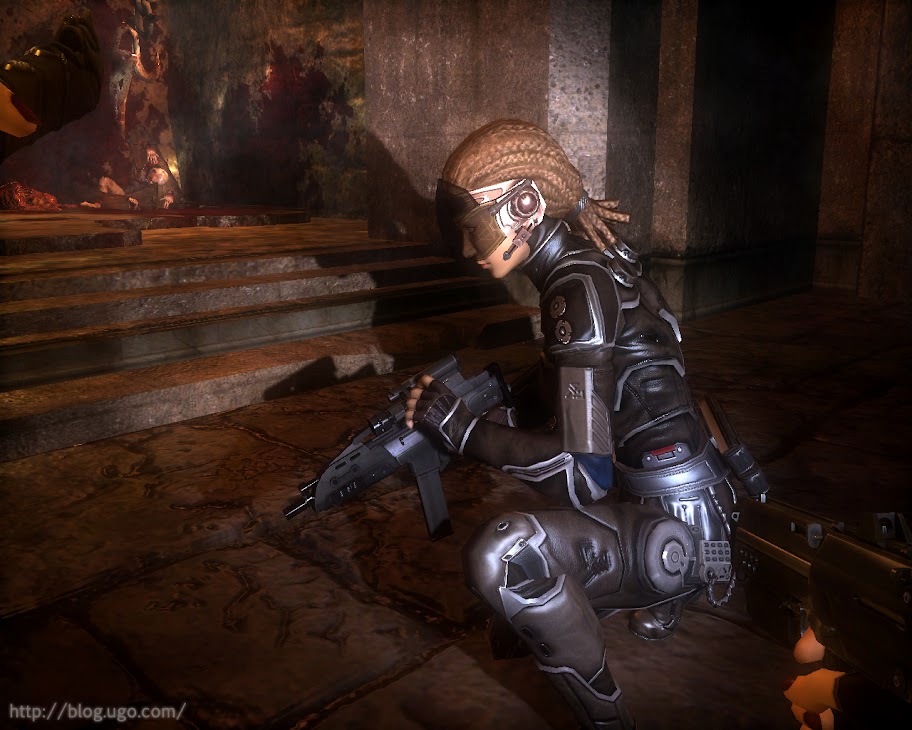 Not only is the story itself brilliant, but the characters are original and highly developed, having unique relationships with one another and characteristics specific to their personalities, although, unfortunately, this is not revealed very well in gameplay. It’s like when you see a movie that’s based on a book. It may be great as a movie alone but usually a lot of good information can be left out. Jericho tries to circumvent this by putting information about the characters in the extras, which can be unlocked with certain achievements (“get 50 headshots”, or “beat this level on hard”, etc). I think, considering the story might be better suited for a novel, Mercury Steam (the developer) has made it work rather terrifically as a game. And, luckily, some of the extras are unlocked simply by passing a level on any difficulty. What is interesting though is that reading some of the information in the extras can give the player more insight and a greater appreciation for the characters. For example, Father Rawlings is sometimes seen ingame as being particularly protective of Billie Church, and it's revealed in the extras that he spent a lot of time training Billie in particular and helping her overcome psychological traumas. It’s also revealed in the extras that Simone Cole had been diagnosed with autism at an early age. She was asked to join the Jericho squad because of her gifted ability with numbers (her skills the player can utilize all are technologically based). Interestingly, in the game, she is seen exhibiting obsessive compulsive habits and some other mild social traits common to those with autism. This is seen not only in an ingame cinematic but also is subtly evidenced even by her very appearance. She has intricate braids set in her hair and one can only imagine she probably counted each and every knot exactly, row by row. –Perfect, no other type of hair would have been more suitable for this character. The NPCs are also very well developed, each having its own history and reason for being. The boss enemies are among the most interesting, and are some of the most evil looking creatures you’ll have ever seen.
 Now then, we’ve covered the plot and characters, let’s get onto the nitty gritty, starting with the visuals. The graphics are pretty good by today's standards. The game seems pretty well optimized too and shouldn't be too hard on your cpu. The bump mapping and specular show in just the right places; surfaces like sand have little specular, but blood and wet rock have a lot more. It can be easy to take this for granted but a lot of games, without naming names (despite the urge), have too much specular or bump mapping on everything, or not enough. And for a game like this, where there is a lot of blood and gore, it's necessary to get this right. Jericho offers a very dynamic POV. To some, the slight, constant movement of the screen might feel awkward at first but you get used to it to a point where it's no longer noticeable (the auto aim helps too though). And even if one finds it annoying it can't be denied that it gives it a very realistic and movie-like feel (as if your character is looking around while listening to others or talking).
With that said, I’d like to segue into gameplay. Some reviewers have complained about the load time—something I entirely disagree with (no one ever complained about the loading in games like Crysis—that’s hella longer than this—oh right, but that was published by EA, oops, sorry, I forgot). The loads are often, but take little time, and they even offer information on the load screens for the player to read to learn more about the story and perhaps feel more immersed in the game. As for the squad mechanic, let's face it, even if you've played other games that gave you the freedom to switch between characters in a squad, it's never had such a good reason as in Jericho; having a soul jump from body to body is a lot cooler and more immersive than simply having the camera change from person to person. Plus the characters don't all feel the same, and while you don't necessarily always need to be switching between them (wouldn't that be annoying?) I think the main reason for it is to give the player options and make him feel more comfortable and unique, not to mention to add to the story.
There is also good voice acting, and this is yet another thing we often can easily take for granted. The shout outs (statements your allies speak when they perform an action or are idle) aren't annoying at all to me as it's not too often you'll hear the same line. I'd often keep my ears open to hear which character was injured; they do a good job at notifying the player of prudent information like that. It is true that they do give hints to the player far too soon, but not too often, so again, you won't be annoyed. Some reviewers, such as Gamespot, have said the script was corny, but I disagree. One thing Gamespot pointed out as corny is when Delgado (a member of the Jericho squad) threatened to eat someone’s soul. I can understand why one would see this as corny, but one needs to realize that the suspension of his disbelief is important in order make the game enjoyable, and this is true for any science fiction work. I mean, come on, the guy has a fire demon housed in his arm. How picky can you be about eating souls when actual demon spirits (and plenty of other paranormal things) exist in this fiction? And the last thing I’ll mention about the script is that the way the characters interact with each other can be funny, but it's not out of place, it serves well as comic relief; this can be appreciated because it’s evident that they are in fact serious when necessary. And hey, if you were battling horrific hellspawn and demons, wouldn’t you want to crack a joke every once in a while so you don’t go out of your mind?
Jericho is a first person “squad-based action horror game based on an original concept and story by acclaimed horror writer and filmmaker Clive Barker.” (official website) Your squad, Jericho, is a team of talented, skilled individuals trained in conventional and occult warfare, or, to put it plainly, “witches with guns”. As a secret division of the US Special Forces, Jericho has been sent to a city in the Middle East, Al-Khali, to perform Operation Godseal. The story, based closely on a Gnostic belief, is that, before man, God had created a perfect being, the Firstborn, but was so disturbed by His creation He forsook it and banished it to a prison known as the “box” or Pyxis (God = Frankenstein!). Throughout the time of man, the Firstborn had seduced many to try and release him—to open a breach into our world so that he could wreak havoc on all of God’s creation. But repeatedly the world was saved by a team of mystics who closed the breach. In the present, a man named Arnold Leech and his followers have committed terrible evil acts such as mass killings and suicides in order to create a “karma bomb” that would effectually reopen the breach. Despite Jericho’s mission, and the past teams of occultists who have saved the world, Jericho was not formed for this purpose; there’s a whole other backstory for that! This is all just a small piece of the intriguing, bold, and believable story in Jericho. What makes the game so believable, and what I love most about the background story, is that many things are taken from real life people, events, sculpture, etc, and are either taken to another level or put in a different context. If one knows a little bit about anthropology and the humanities it becomes very evident that the writers did their homework.
Not only is the story itself brilliant, but the characters are original and highly developed, having unique relationships with one another and characteristics specific to their personalities, although, unfortunately, this is not revealed very well in gameplay. It’s like when you see a movie that’s based on a book. It may be great as a movie alone but usually a lot of good information can be left out. Jericho tries to circumvent this by putting information about the characters in the extras, which can be unlocked with certain achievements (“get 50 headshots”, or “beat this level on hard”, etc). I think, considering the story might be better suited for a novel, Mercury Steam (the developer) has made it work rather terrifically as a game. And, luckily, some of the extras are unlocked simply by passing a level on any difficulty. What is interesting though is that reading some of the information in the extras can give the player more insight and a greater appreciation for the characters. For example, Father Rawlings is sometimes seen ingame as being particularly protective of Billie Church, and it's revealed in the extras that he spent a lot of time training Billie in particular and helping her overcome psychological traumas. It’s also revealed in the extras that Simone Cole had been diagnosed with autism at an early age. She was asked to join the Jericho squad because of her gifted ability with numbers (her skills the player can utilize all are technologically based). Interestingly, in the game, she is seen exhibiting obsessive compulsive habits and some other mild social traits common to those with autism. This is seen not only in an ingame cinematic but also is subtly evidenced even by her very appearance. She has intricate braids set in her hair and one can only imagine she probably counted each and every knot exactly, row by row. –Perfect, no other type of hair would have been more suitable for this character. The NPCs are also very well developed, each having its own history and reason for being. The boss enemies are among the most interesting, and are some of the most evil looking creatures you’ll have ever seen. Now then, we’ve covered the plot and characters, let’s get onto the nitty gritty, starting with the visuals. The graphics are pretty good by today's standards. The game seems pretty well optimized too and shouldn't be too hard on your cpu. The bump mapping and specular show in just the right places; surfaces like sand have little specular, but blood and wet rock have a lot more. It can be easy to take this for granted but a lot of games, without naming names (despite the urge), have too much specular or bump mapping on everything, or not enough. And for a game like this, where there is a lot of blood and gore, it's necessary to get this right. Jericho offers a very dynamic POV. To some, the slight, constant movement of the screen might feel awkward at first but you get used to it to a point where it's no longer noticeable (the auto aim helps too though). And even if one finds it annoying it can't be denied that it gives it a very realistic and movie-like feel (as if your character is looking around while listening to others or talking).
With that said, I’d like to segue into gameplay. Some reviewers have complained about the load time—something I entirely disagree with (no one ever complained about the loading in games like Crysis—that’s hella longer than this—oh right, but that was published by EA, oops, sorry, I forgot). The loads are often, but take little time, and they even offer information on the load screens for the player to read to learn more about the story and perhaps feel more immersed in the game. As for the squad mechanic, let's face it, even if you've played other games that gave you the freedom to switch between characters in a squad, it's never had such a good reason as in Jericho; having a soul jump from body to body is a lot cooler and more immersive than simply having the camera change from person to person. Plus the characters don't all feel the same, and while you don't necessarily always need to be switching between them (wouldn't that be annoying?) I think the main reason for it is to give the player options and make him feel more comfortable and unique, not to mention to add to the story.
There is also good voice acting, and this is yet another thing we often can easily take for granted. The shout outs (statements your allies speak when they perform an action or are idle) aren't annoying at all to me as it's not too often you'll hear the same line. I'd often keep my ears open to hear which character was injured; they do a good job at notifying the player of prudent information like that. It is true that they do give hints to the player far too soon, but not too often, so again, you won't be annoyed. Some reviewers, such as Gamespot, have said the script was corny, but I disagree. One thing Gamespot pointed out as corny is when Delgado (a member of the Jericho squad) threatened to eat someone’s soul. I can understand why one would see this as corny, but one needs to realize that the suspension of his disbelief is important in order make the game enjoyable, and this is true for any science fiction work. I mean, come on, the guy has a fire demon housed in his arm. How picky can you be about eating souls when actual demon spirits (and plenty of other paranormal things) exist in this fiction? And the last thing I’ll mention about the script is that the way the characters interact with each other can be funny, but it's not out of place, it serves well as comic relief; this can be appreciated because it’s evident that they are in fact serious when necessary. And hey, if you were battling horrific hellspawn and demons, wouldn’t you want to crack a joke every once in a while so you don’t go out of your mind?
Like most any game, it's not without it's flaws, but Jericho is a brilliant game and has been truly underappreciated by most critics. But if in games you appreciate a well written fantasy fiction with macabre religious and historic overtones, or are simply looking for an exciting fps, you’d definitely get your money’s worth with Jericho, and perhaps a new favorite.
Tuesday, April 14, 2009
Reassessment and Map Review
 At GDC 2009 in San Francisco, the most valuable thing I got out of it this year was input from developers on my portfolio. There were some good sessions and super nice people, but, as so many more studios are only hiring experienced developers (a symptom of the economy I assume, as even experienced devs are having trouble finding work this time around) the thing I took most from GDC this year was that I simply need more experience, more work in my portfolio, and more recognition.
The best critique I got on my work was from Jim Hughes, one of Valve’s level designers who is credited for having worked on games like Quake 2, Half-Life 2: Ep1, Portal, Left 4 Dead, and more. I shared with him my completed sa_trainyard Team Fortress 2 map and some concept sketches for other maps I have planned. It was great having the opportunity to sit down with an accomplished developer and bounce ideas off of him. A lot of things he said really helped me, and it wouldn’t have been a critique if what he said didn’t make me think of new ways to improve my technique and better develop my portfolio. And so, without further tarry, I wanted to just briefly review some points that have been made about my sniper map in particular as it is crucial to personal development for one to review his mistakes and learn from them.
 One of the first things Jim noticed in my map was a harsh, obvious divide between the Red and Blu bases. He is the first person to really point this out to me, and he noted that although it could be seen as “clever” by some, such a clear, straight divide is visually distracting and disrupts the continuity of the map’s design. He mentioned that Valve makes a point of avoiding such harsh edges or sudden changes in color when laying out their map designs, especially for TF2. Also, because of the way the source engine deals with edges, Valve’s level designers sometimes use things like models to break up the continuity and blandness in sharp, straight edges.
As far as gameplay, froggie, from FPSBanana, mentioned that sniping from the ground outside the bases seemed especially difficult because there aren’t as many angles to snipe from as there are on the upper levels of the buildings and because it’s simply hard to get “a clear shot”. I was a little surprised by this, although I did have an inkling about it. I’ve always sort of seen the outside ground area as, definitely, a less secure place to snipe from as there is not much directly available cover. Therefore I’ve seen it as a place most players would often not venture except to surprise their enemy with a new and unexpected location. At first I wasn’t entirely sure why froggie had trouble getting a clear shot. In development and play testing, I had actually gone through the trouble of building solid brushes inside some of the train models whose bounding boxes were too large, so that the players wouldn’t have their bullets stopping in mid-air. Although, what I figure is the problem is that the trains, used to divide the two bases, block a lot of the player’s line of sight. This is why, in reality, most snipers shoot from high windows and towers. But I notice that most TF2 maps have their ground areas open enough so that snipers can remain at ground level and still have little blocking their view of the incoming enemies. In fact, most sniper maps have the ground level open too. Oops.
 A common criticism is the map’s class restriction. Despite the fact that some people do seek out maps such as this, the criticism is wholly valid. It may give players a safe environment to hone in their skills and perhaps learn from other snipers, but it’s ultimately very exclusive. I knew this when I decided to make the map. But I chose this map for two simple reasons: there were no attractive sniper maps (which really bugged me!), and, more importantly, I wanted something basic and small to work on so I could focus more on the visual aesthetic rather than on things like class balancing. But what I really didn’t think about was why this exclusivity was really such a bad thing. As Jim pointed out to me, it forces the map to stay in seclusion, away from a large percentage of players who simply couldn’t care less about sniping (and these players needs loves too). Maps that permit the use of all classes gain far more publicity because they’re simply more in demand and, for an aspiring video game artist, wide spread renown for your work is invaluable.
Therefore I think the best direction I could go in from here would be to begin work on a CTF map I have conceptualized for TF2. I will of course release more information as the project begins to take form. Until then, have a great week!
Subscribe to:
Posts (Atom)